Fast Food Menu Hacks have turned ordering into a full-on game, and America is playing it like a sport. What used to be “I’ll take a #3” is now “hold on, let me build this like a playlist.”
Fast food menu hacks are basically the internet’s new sport 🏆
There was a time when fast food felt simple. You showed up, pointed at a combo, and went back to your car with a bag of predictable comfort. But the internet doesn’t do “predictable” anymore.
Now it’s: upgrade the bun, swap the sauce, double the crunch, add the thing from the other menu category, and suddenly your basic order is a custom build with lore, like it’s a limited-edition drop.
That’s the heartbeat of Fast Food Menu Hacks. They’re not just “secret menu items.” They’re the internet remixing the menu in real time, then daring everyone else to try it.
Why “off-menu” feels like a flex
Let’s be honest: half the appeal is psychological. Ordering the same burger everyone else orders is fine. Ordering the same burger but “the better version” feels like winning.
The vibe is “I know something you don’t,” even if the “something” is just a combination of existing ingredients and a confident tone at the counter.
If you want the clean definition to anchor the whole trend, start with what a menu hack actually is. It’s the simplest way to explain why these combos spread so fast: they’re easy to copy, easy to share, and they make people feel clever.
The “I discovered this” dopamine hit
Fast food hacks hit the brain like a tiny treasure hunt. You’re not just eating. You’re participating.
A hack feels like it was “found,” not sold. And in a world where everything is an ad, people are obsessed with anything that feels like a loophole.
That’s why hack culture shows up in food so hard. You’re taking a menu designed to guide you… and making it do what you want.
If you want the consumer-behavior angle that explains why customization is so addictive, why we love custom eats breaks down how these hacks emerge from customers and spread socially, not top-down.
TikTok turned ordering into a remix culture 🎥
TikTok didn’t invent Fast Food Menu Hacks. But it industrialized them.
Before TikTok, hacks lived on forums, Reddit threads, and “friend of a friend” whispers. TikTok made them visual, repeatable, and fast.
The result? Millions of people watching a 12-second clip and thinking: “That. I need that.”
Viral format + short attention spans = hack machine
TikTok rewards three things that hacks deliver perfectly: speed, surprise, and shareability.
A creator walks into a chain, orders “the thing,” reveals the result, takes a bite, reacts dramatically, and boom, your feed is now a national test kitchen.
And here’s the key part: restaurants can’t fully control it. A hack can go viral without a brand ever planning for it, approving it, or even liking it. But once it’s trending, the chain is suddenly part of the storyline.
That’s why the industry has started treating TikTok like it’s not just marketing. It’s menu influence. It’s demand creation.
If you want the cleanest “this is the new reality” industry take, TikTok is basically a second menu board is the phrase that explains the entire moment.
The comment section is the real secret menu
This is where it gets spicy: the best hacks often aren’t in the video. They’re in the comments.
Someone posts “order it like this,” then three people reply with improvements, and suddenly the hack evolves like it’s getting patches in real time.
It’s basically open-source food.
Creators who live in this space aren’t just posting recipes. They’re shaping cravings. They’re creating mini trends that spread faster than most brands can react.
If you’ve been watching how food trends become culture, you’ve already seen this pattern. Snackfluencers changing what you eat is a perfect example of how “what went viral” turns into “what people buy” almost immediately.
Must-try fast food menu hacks (and how to order without chaos) 🍔
Here’s the thing: most hacks are fun. Some are genius. A few are… a cry for help.
The goal isn’t to turn every order into a chemistry experiment. The goal is to know which hacks actually level up your meal without turning you into the main character in a stressed-out drive-thru line.
The “build-a-better-burger” era (McDonald’s, Taco Bell, and friends)
The most common hack archetype is simple: combine two beloved things and let nostalgia do the heavy lifting.
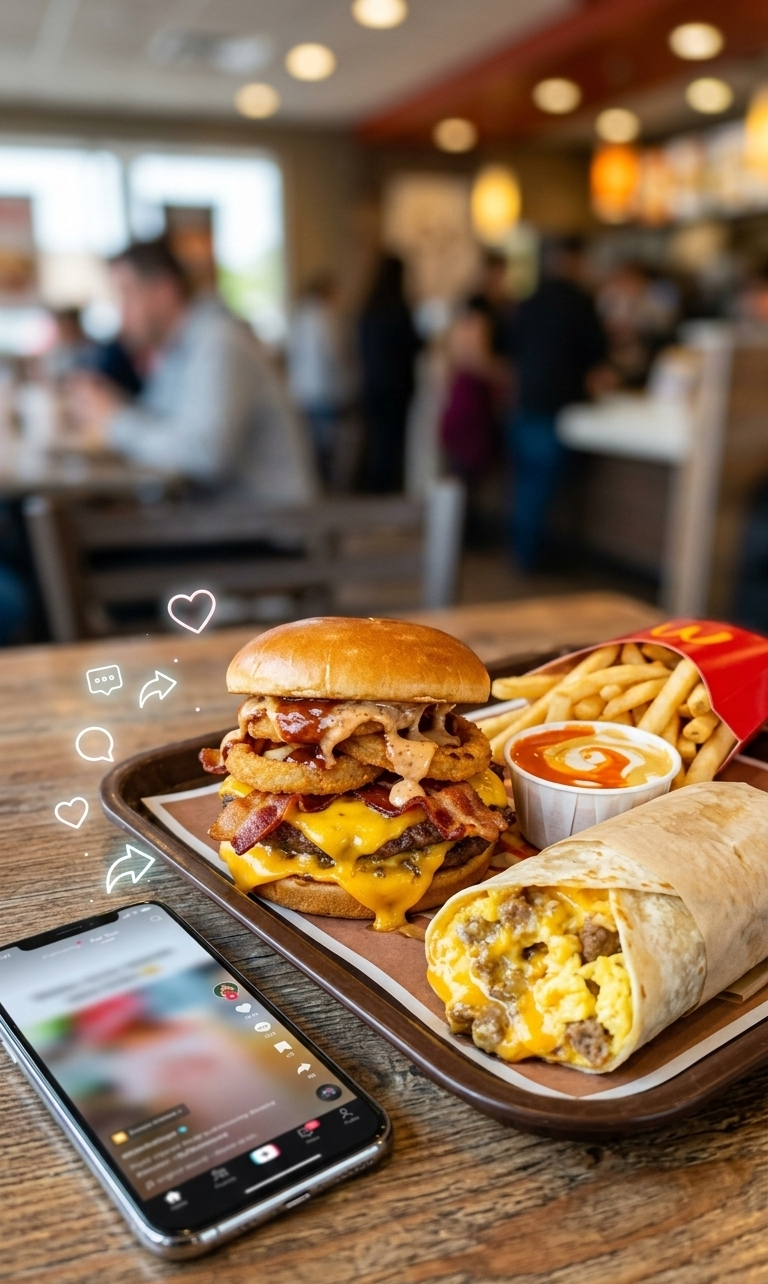
The Breakfast-Lunch Smash: Breakfast sandwich energy + burger energy. People love it because it feels like you’re bending time.
Pro move: keep it realistic. Ask for add-ons that already exist in the system (extra sauce, extra pickles, add bacon) rather than a full “Franken-order” with a speech.
Crunch upgrades: Anything that adds texture goes viral. Fries inside a burrito. Crispy strips inside a sandwich. A crunchy shell inside a soft shell.
Why it works: crunch reads as “premium” even when it’s just a texture swap.
Sauce stacking: People underestimate sauce. Sauce is identity. Sauce turns “this tastes like every other burger” into “wait, why is this weirdly good?”
If you want a quick reality check on which viral hacks actually taste good (and which are pure internet theater), this video on testing viral TikTok fast food hacks hits the exact vibe: try it, rate it, keep the ones that actually work.
Coffee chain hacks that look like a cheat code (and sometimes are)
Coffee hacks go viral because they’re visually satisfying and feel like a luxury upgrade.
It’s not just “a drink.” It’s “a drink with a build.”
People love:
- adding cold foam textures
- swapping syrups
- mixing flavors that feel like dessert
- ordering something that looks like a secret handshake
And here’s the hidden truth: menu layout and pricing psychology quietly influence how people hack. The menu is designed to guide you toward certain choices, but hack culture pushes back. Customers want control.
If you want the brainy explanation of how menus nudge decisions in the first place, the psychology of menu design is a classic read. Once you know how menus steer attention, hacks make even more sense: people feel like they’re outsmarting the system.
How to order hacks without annoying the staff
This is the part the internet skips, but real life does not.
A hack works best when:
- it can be rung up using existing modifiers
- it doesn’t require a long explanation
- it doesn’t create a custom workflow during rush hour
Pro tips that make you look like a normal human:
- Order in “steps,” not speeches. Start with the base item, then add modifications.
- Use official language when possible (extra sauce, add bacon, no onions).
- If it’s a complicated build, go inside or use the app, where customization is built for this.
- Don’t argue if they say no. A hack is not a human right.
A Redditor once summed it up perfectly: “The hack works, but you have to say it like you’ve done it before.” (That’s not just funny, that’s operational advice.)
Why these hacks win: personalization, value, and the thrill of the secret 🤫
Fast food hacks aren’t just about taste. They’re about control.
People aren’t satisfied with being a passive customer. They want to co-create. They want a meal that feels personal, even if it’s built from the same ingredients as everyone else’s order.
Customization makes it feel like your meal
A “standard” menu item feels like a product.
A hacked menu item feels like a creation.
That’s why customization hits so hard. You get to play chef without needing a kitchen. You get novelty without needing a new restaurant. And you get the social bonus of “I tried the thing.”
This is exactly why why we love custom eats resonates: hacks feel like customer-driven innovation, and people love feeling like they’re part of the invention.
A TikTok user put it in the most internet way possible: “I ordered it exactly like the video and it tasted illegal.”
That’s the whole phenomenon in one sentence.
The fine line between fun and “please stop”
Hacks are fun until they become friction.
If your “hack” requires:
- a custom build with six substitutions
- a long explanation at the speaker
- ingredients the location doesn’t have
- or a staff member to become your personal food engineer
…then you’re not hacking the menu. You’re hacking someone’s patience.
This is why it helps to remember the definition and spirit behind what a menu hack actually is. The best hacks are clever combinations of what already exists. The worst are fantasy orders pretending every location is a fully staffed test kitchen.
The future: brands copy the hacks, then sell them back to us
Here’s where it gets hilarious: once a hack gets big enough, brands start “officializing” it.
They’ll package the vibe, name it, market it, and suddenly the thing that felt like a secret becomes a promoted limited-time item.
That’s not a coincidence. That’s strategy.
From unofficial “hack” to official limited-time drop
Brands have realized something important: customers don’t just want food. They want participation.
A viral hack is basically:
- free R&D
- free marketing
- free social proof
- and free demand forecasting
So it makes sense that companies are watching TikTok trends like it’s a real-time sales dashboard.
Again: TikTok is basically a second menu board isn’t just a catchy line. It’s the blueprint for how fast food is adapting to internet culture.
An X user joked, “Fast food is basically DLC now. Same menu, infinite upgrades.”
And honestly? That might be the most accurate business analysis of the decade.
More food trends to keep on your radar
Fast Food Menu Hacks are part of a bigger pattern: consumers shaping products in public, in real time, with social media as the engine.
If you’re into this kind of trend-tracking, it helps to have a home base for the broader movement beyond just hacks. BigTrending’s Food trend hub is a solid place to keep tabs on what’s rising, what’s fading, and what’s about to land on everyone’s feed next.
FAQ
What are Fast Food Menu Hacks?
Fast Food Menu Hacks are customer-created custom orders or combinations using existing menu items and modifications, often shared on TikTok, Reddit, or X.
Are Fast Food Menu Hacks actually “secret menu items”?
Sometimes, but not always. Many Fast Food Menu Hacks are just clever combinations anyone can order if the ingredients and modifiers exist at that location.
How do I order Fast Food Menu Hacks without problems?
Keep it simple, use menu modifiers, and avoid long explanations at the speaker. If it’s complex, order inside or through the app where customization is easier.
Why do Fast Food Menu Hacks go viral so fast?
Because they’re visual, easy to copy, and feel like a “hidden” upgrade. Social platforms reward quick, surprising content, and hacks deliver that perfectly.
Will fast food brands turn hacks into official items?
Yes, and it’s already happening. Brands watch viral hacks and sometimes convert them into limited-time items because it’s proven demand with built-in hype.