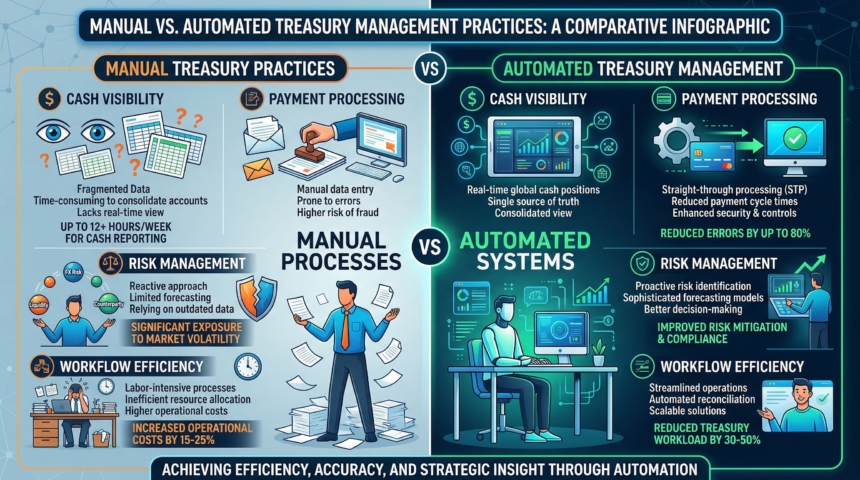
The shift in corporate finance is happening faster than most CFOs anticipated. Finance leaders now face a blunt choice: stick with the comfort of familiar spreadsheets or embrace the efficiency of modern technology. When evaluating manual vs automated treasury management, the decision dictates whether a firm merely survives on historical data or thrives on real-time intelligence.
Modern finance departments are evolving to meet the demands of a high-speed global economy. This evolution centers on digital ecosystems that strip away the heavy lifting of traditional financial reporting.
Manual vs Automated Treasury Management: 5 Essential Keys to Modern Success
Treasury management has long been the backbone of corporate stability. For decades, this meant legions of analysts logging into banking portals, downloading CSV files, and stitching them together in Excel. This manual vs automated treasury management debate is no longer about convenience; it is about institutional risk.
In a world of hourly interest rate fluctuations and geopolitical disruptions, "manual" processes are liabilities. Relying on human entry for million-dollar transactions introduces a margin for error that modern boards find unacceptable. The core difference between manual vs automated treasury management is the gap between reactive accounting and proactive capital deployment.
Automated systems provide a consolidated view of cash positions across multiple currencies in seconds. This speed drives the mass migration away from legacy processes. Finance teams are realizing that talent is wasted on data entry when it could be used for strategic forecasting and risk mitigation.
Understanding the Core Differences in Modern Finance
The fundamental divide in manual vs automated treasury management lies in data integrity. Manual processes rely on "human middleware"—people acting as bridges between banking systems and internal software. This creates a fragmented environment where data is often outdated the moment it hits a shared drive.
Automated treasury management systems (TMS) or specialized treasury management system implementation workflows remove this friction. By using APIs to pull data directly from banks, treasurers see their global position at the start of every business day. This shift from batch processing to real-time visibility defines the manual vs automated treasury management transition.
Scalability is often capped by manual constraints. A company expanding into international markets will find that manual vs automated treasury management becomes a major bottleneck. Each new bank account adds exponential complexity to a spreadsheet, while an automated system handles the extra data with minimal effort.
The Hidden Costs of Legacy Processes
Many CFOs hesitate to automate because of perceived upfront software costs. However, a deep dive into manual vs automated treasury management reveals that the "free" spreadsheet approach is incredibly expensive. You must account for labor hours spent on reconciliations, the cost of human error, and the opportunity cost of idle cash.
Manual vs automated treasury management comparisons must also highlight fraud risks. Manual processes are notoriously vulnerable to internal and external tampering. Without automated audit trails, a company is much more susceptible to business email compromise (BEC) and unauthorized disbursements.
Operational resilience is another point where manual vs automated treasury management diverges. If the person managing the "Master Spreadsheet" leaves, the entire department can grind to a halt. Automation institutionalizes knowledge, ensuring processes continue regardless of personnel changes. You can learn more about treasury management practices to see how modern firms are de-risking their operations.
Real-Time Liquidity and Cash Forecasting
A massive advantage in the manual vs automated treasury management spectrum is forecasting accuracy. Manual forecasts rely on "gut feel" or stale historical trends. Because the data is old, the forecast is inherently flawed.
Automated systems use machine learning and historical patterns to predict future cash needs with high precision. By comparing manual vs automated treasury management results, firms often find that automation reduces forecasting variance by up to 50%. This allows companies to maintain lower cash buffers and put more capital to work.
Many firms use ai for bank reconciliation to bridge the gap. This technology matches thousands of transactions in minutes—a task that takes humans days. This specific application of manual vs automated treasury management demonstrates how AI eliminates the most tedious aspects of the job.
Security and Compliance in the Digital Age
The regulatory environment is becoming stricter, requiring detailed reporting on liquidity and risk. In the manual vs automated treasury management battle, automation wins on compliance. Automated systems generate instant, audit-ready reports that track every approval and transaction.
Cybersecurity is a major driver in the manual vs automated treasury management discussion. Modern platforms use multi-factor authentication and end-to-end encryption to move money. Manual processes involving emailed spreadsheets or shared bank passwords are a security nightmare.
By moving toward an automated model, companies implement strict "Segregation of Duties" (SoD) through software permissions. This is hard to enforce in a manual environment where one user might have full access to the company's entire cash movement. The manual vs automated treasury management choice is a choice about the fundamental security of assets.
Strategic Practical Takeaways for Finance Leaders
Transitioning from manual vs automated treasury management is not an overnight process. Leaders should focus on high-volume, low-value tasks like bank statement retrieval first. Explore case studies on financial automation to see how others have staged their rollout.
Ensure your team is upskilled. The move from manual vs automated treasury management changes the job from "data entry" to "financial analyst." Employees must learn to interpret data rather than just compile it.
Look for modular platforms. You don't have to automate everything at once. Starting with cash visibility and then moving into automated payments allows for a smoother transition in the manual vs automated treasury management journey. Keep a close eye on data quality from your bank feeds.
- Eliminate Data Silos: Centralize data from all banking partners into a single source of truth.
- Focus on Exception Management: Shift the team’s focus to only investigating anomalies flagged by the system.
- Enhance Forecasting Accuracy: Use AI-driven tools to move beyond simple linear projections.
- Strengthen Internal Controls: Implement digital workflows that require multiple approval levels.
The Future of Global Treasury Operations
The gap between manual vs automated treasury management will only widen. We are entering an era of "invisible treasury," where routine tasks are handled by background processes. This allows the treasurer to act as a strategic advisor to the CEO.
Technologies like blockchain and real-time payment rails make manual vs automated treasury management even more lopsided. Humans cannot keep up with 24/7/365 instant settlements. Companies tethered to manual processes will be unable to compete.
A report by Deloitte on Treasury Management notes that advanced analytics is now a "must-have." This underscores that manual vs automated treasury management is a defining factor in corporate resilience. The future belongs to those who turn data into a competitive advantage.
Conclusion: Making the Pivot
Choosing between manual vs automated treasury management is a choice about the future of your finance department. While manual approaches feel "safe" because they are familiar, they carry a heavy burden of risk and missed opportunity.
Embracing automated tools lets finance teams reclaim their time for work that drives value. The manual vs automated treasury management debate is effectively over. The only question is how quickly your organization can adapt.
Frequently Asked Questions (FAQ)
1. What is the biggest risk in staying with manual treasury management?
The biggest risk is the lack of real-time visibility. In manual vs automated treasury management, the manual side suffers from "blind spots" where cash positions are unknown for days, leading to liquidity crises.
2. Is automated treasury management only for large corporations?
No. Mid-market companies are increasingly moving toward automation. The manual vs automated treasury management shift is accessible to smaller firms via cloud-based SaaS solutions.
3. How does automation improve bank relationships?
Automation streamlines communication through standardized formats like ISO 20022. It reduces the need for constant phone calls and manual queries, as data flows seamlessly into internal systems.
4. Can manual vs automated treasury management coexist during a transition?
Yes, most companies use a hybrid approach. You might automate primary domestic accounts first while keeping manual processes for smaller regional banks until they are integrated.