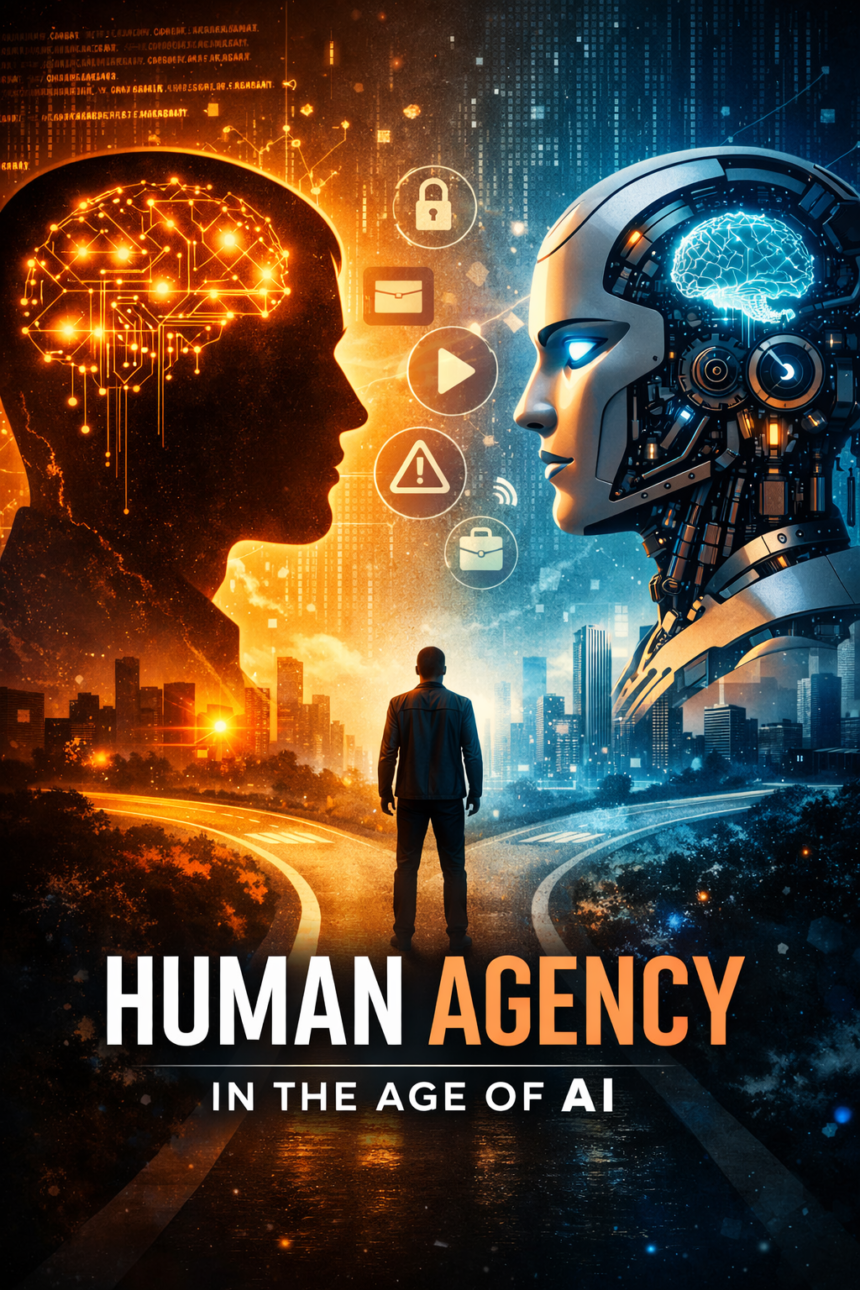
Human agency used to be the default setting. Now it feels more like something we have to actively protect.
AI is making life faster, smoother, and weirdly more convenient, but that same convenience can quietly train us to stop choosing, questioning, and thinking as much for ourselves.
AI has a branding problem and a power problem.
The branding problem is easy to spot. Every week, some new tool shows up promising to write better, predict faster, optimize harder, and remove “friction” from your life. It sounds helpful because, honestly, a lot of it is helpful. The power problem is trickier. The more these systems help, the more they shape the environment in which your choices happen.
That is where human agency starts to matter in a much deeper way than the usual “tech is changing everything” headline.
This is not just about robots taking jobs or students using chatbots for homework. It is about something more intimate: who gets to decide what matters, what gets prioritized, what options you see, and how much of your own judgment you still use when a machine is always ready to suggest the next move.
A lot of people already feel this tension without using academic language for it. A TikTok user put it perfectly: “I love AI for speed, but I hate how fast it becomes the default brain.”
Yep. That is the vibe.
AI Is Amazing, and That’s Exactly Why People Are Nervous
Let’s be fair before we get dramatic.
AI is not just hype wrapped in glossy demos. It is already doing genuinely useful work in medicine, logistics, search, fraud detection, customer support, accessibility, and scientific research. It catches patterns humans miss. It works at a scale humans cannot. It turns giant piles of data into decisions in seconds.
That is why the conversation around human agency gets messy so fast. The technology is not useless. It is powerful enough to be irresistible.
You can see that tension even in a recent BigTrending look at AI automation implementation roadmaps, where the central idea is not replacing people outright, but augmenting what they do. That sounds healthy, and sometimes it is. But augmentation has a sneaky side effect. Once a system becomes reliable enough, people stop treating it like support and start treating it like authority.
That shift matters.
A spellcheck tool does not threaten your identity. A system that ranks job applicants, determines risk, shapes the news you see, recommends your investments, or influences how you spend your day? Different story.
And AI adoption is not slowing down into some calm, manageable pace either. The Stanford AI Index 2025 keeps reinforcing the same big picture: capability is advancing, deployment is spreading, and AI is becoming normal infrastructure rather than a novelty. Once that happens, people stop asking whether they should rely on it and start assuming they already do.
The convenience trap nobody talks about
Convenience is not neutral. That is the part many people miss.
Every time a system saves you a little effort, it also reduces one small opportunity to practice judgment. Not always a big deal. But stack enough of those moments together and you get a culture that confuses ease with wisdom.
Think about navigation apps. Most of us now follow directions instead of learning routes. Streaming platforms decide what we watch next. Social feeds decide what deserves our attention. Recommendation engines decide what feels relevant. None of this sounds apocalyptic on its own. Together, though, it changes the texture of daily life.
You stop exploring as much. You compare less. You trust your instincts less. You stop pausing to ask, “Why this option?”
That is how human agency fades, not with a cinematic robot uprising, but with tiny habits of surrender.
When Convenience Starts Rewriting Choice
There is a big difference between being helped and being steered.
That difference gets blurry when AI becomes the layer between you and reality. If a system curates the candidates you interview, the routes you drive, the articles you read, the deals you see, and the music you hear, then your “choices” are happening inside a machine-shaped menu.
You are still choosing. But from a narrowed set.
That is where algorithmic decision-making becomes more than a technical feature. It becomes an invisible architecture for everyday life.
Algorithmic decision-making feels helpful until it feels invisible
One of the weirdest things about modern AI systems is that they often feel benign right up until you realize how much of the process you never saw.
A recommendation engine does not tell you what it excluded. A ranking model does not show the human assumptions baked into the data. A personalization layer does not announce, “Hey, I am limiting your world based on your past behavior.”
It just works.
And people love things that just work.
The problem is that “just works” can slowly become “just accept.” That is why frameworks like the NIST AI Risk Management Framework matter so much. Not because regular people wake up excited to read policy documents, but because someone has to build systems that are explainable, governable, and reviewable before they become impossible to question at scale.
An X user summed it up in one line: “AI should be a co-pilot, not the CEO of your life.”
That is the whole argument in miniature.
The quiet erosion of critical thinking
Critical thinking is not a personality trait you either have or do not have. It is a habit. And habits weaken when they are not used.
If AI summarizes everything for you, drafts everything for you, recommends everything for you, and filters everything for you, then your brain starts adjusting to a lower workload. Again, not instantly. Quietly.
Students use AI to shortcut the messy early phase of thinking. Workers use it to produce polished outputs without fully wrestling with the problem. Consumers use it to avoid comparing, researching, or reflecting. The result is not that people become unintelligent. It is that they become less practiced at deliberate thought.
That is a big deal.
Because human agency depends on more than having options. It depends on having the mental stamina to evaluate them.
The Social Cost of Letting the Machine Drive
Once this leaves the personal level, the stakes get bigger fast.
We are not only talking about your playlist or your shopping cart. We are talking about labor markets, surveillance, bias, politics, and power.
Jobs, privacy, and political influence
The jobs question is obvious and still huge. AI is not only automating repetitive tasks. It is increasingly touching creative, analytical, and managerial work too. That does not mean every role disappears, but it does mean many roles get redefined under pressure. Workers are told to adapt, reskill, and move faster, while institutions often lag behind.
At the same time, privacy becomes thinner. If systems improve by absorbing more data, then data collection becomes baked into the business model. That is one reason BigTrending’s broader technology coverage keeps circling back to digital systems that promise ease while quietly expanding what gets tracked, analyzed, and inferred.
Political influence is another headache. AI-generated content can flood feeds, mimic authenticity, and micro-target people at scale. It becomes harder to know what is real, what is manipulation, and what was optimized simply because it performs well emotionally.
A Redditor said it with dark honesty: “The scary part isn’t evil robots, it’s humans slowly giving up small decisions every day.”
That line lands because it is not just about personal habits. It is about social drift.
Bias does not disappear just because the interface looks smart
One of the most dangerous myths in tech is that automation is automatically more objective than people.
Sometimes it is less emotional. Sometimes it is more consistent. But consistency is not the same as fairness.
If a model is trained on biased historical data, it can reproduce old inequalities with new confidence. Hiring, lending, policing, healthcare access, insurance pricing, moderation decisions, these systems can carry bias forward while hiding it behind clean interfaces and technical language.
That is exactly why the EU AI Act matters. Its whole risk-based logic reflects a simple truth: not all AI uses are equally dangerous, and systems that affect rights, access, or opportunity deserve much more scrutiny than a harmless image filter or playlist tool.
Human agency gets hit especially hard when biased systems shape life chances before a person even knows the system exists.
AGI, Superintelligence, and the Real Fear Under the Fear
Now we get to the part people either overhype or dismiss too casually.
Yes, some fears around AI are theatrical. But not all of them are silly.
The concern around highly advanced systems is not just “killer robots.” It is loss of control. Loss of interpretability. Loss of meaningful human leverage.
Why the point-of-no-return idea sticks in people’s heads
People keep talking about AGI because it sits at the intersection of real technical ambition and deep existential anxiety. The idea of artificial general intelligence is basically the idea of a system that can perform across a wide range of cognitive tasks at or beyond human level.
Whether AGI is close, far, misdefined, or overmarketed is still debated. But the emotional reason the topic sticks is obvious. Once people imagine systems that can reason, improve, and operate with broad competence, they start asking a brutal question: what remains distinctly ours?
That is not only a labor question. It is a meaning question.
The difference between smarter tools and systems we can’t steer
There is a massive difference between a stronger calculator and a system that becomes structurally central to economies, institutions, and public life.
The real fear is not that machines become dramatic villains. The real fear is that humans build systems so capable, so embedded, and so difficult to challenge that decisions start flowing around us rather than through us.
At that point, human agency is no longer about individual willpower. It becomes a governance issue.
Who sets the goals?
Who audits the outcomes?
Who can stop the system?
Who is accountable when harm scales?
Those are not sci-fi questions anymore. Those are design questions.
How to Keep Human Agency in the Loop
The good news is that none of this is inevitable.
AI does not automatically erase human control. But preserving that control takes intention. Real intention. Not vague ethics statements slapped onto a launch blog post.
Build guardrails before the technology hardens into habit
The smartest move is to set rules early, before dependence becomes normal and expensive to reverse.
That means transparency requirements. Audit trails. Human review where stakes are high. Clear liability. Limits on surveillance-heavy deployment. Standards for explainability where decisions affect real lives.
It also means taking seriously broader governance thinking, like OECD-style human-centered AI principles, which push the conversation away from “Can we build it?” and toward “What kind of system are we normalizing, and for whose benefit?”
A practical pro tip here: do not wait until a system feels harmful to ask whether it is accountable. Ask that before it becomes routine.
Double down on the skills AI cannot live for us
This is where the article stops being abstract and gets personal again.
If you want to protect human agency, do not just learn how to use AI. Learn how not to disappear inside it.
That means practicing the things machines can support but not meaningfully live for you: moral judgment, taste, empathy, synthesis, context awareness, courage, patience, creative leaps, and the ability to sit with uncertainty.
Schools, companies, and families should be talking about this more directly. Not just “learn prompting,” but also:
- how to verify instead of blindly accept
- how to pause before outsourcing thought
- how to question recommendations
- how to keep a human reason for the decision, not just an efficient one
This is also where global ethical efforts like UNESCO’s AI ethics recommendation matter. They push the conversation toward dignity, rights, and social impact instead of treating intelligence as merely a productivity tool.
The Real Goal Is Not Less AI, It’s Better Human Control
There is a lazy version of this debate where one side says AI will save us and the other says AI will destroy us.
Both are too simple.
The more useful framing is this: AI will amplify whatever kind of social design, political courage, business incentives, and cultural habits we bring into it.
If we normalize passivity, concentration of power, and unexamined automation, then human agency will keep shrinking even while our tools get shinier. If we build around accountability, participation, and genuinely human priorities, then AI can become something much better than a replacement fantasy.
It can become infrastructure for better decisions without becoming the author of our lives.
A human-centric future is still a design choice
This is the part worth ending on.
A human-centric future does not happen because people say “responsible AI” enough times at conferences. It happens when designers, companies, schools, governments, and ordinary users refuse to confuse intelligence with legitimacy.
A tool can be fast and still wrong.
A model can be impressive and still unfair.
A recommendation can be accurate and still not be right for you.
That is the heartbeat of human agency.
The question is not whether AI will keep getting stronger. It will. The question is whether humans will keep practicing the forms of judgment that make freedom real in the first place.
That is still up to us.
FAQ
What does human agency mean in the context of AI?
In the context of AI, human agency means your ability to make meaningful decisions, apply judgment, and act intentionally rather than simply following automated suggestions or machine-shaped options.
Why is human agency important if AI makes life easier?
Because convenience can quietly reduce independence. If AI handles more decisions without transparency or reflection, human agency can weaken even while daily life feels smoother.
Can AI and human agency work together?
Yes. The healthiest model is collaboration, where AI handles pattern recognition and speed while people retain responsibility for context, ethics, priorities, and final decisions.
Does protecting human agency mean rejecting AI?
Not at all. Protecting human agency means using AI with limits, oversight, and awareness so people stay in control of what matters most.
How can I strengthen human agency in daily life?
Start small: question recommendations, verify important outputs, avoid outsourcing every hard decision, and keep practicing critical thinking instead of treating AI as automatic authority.