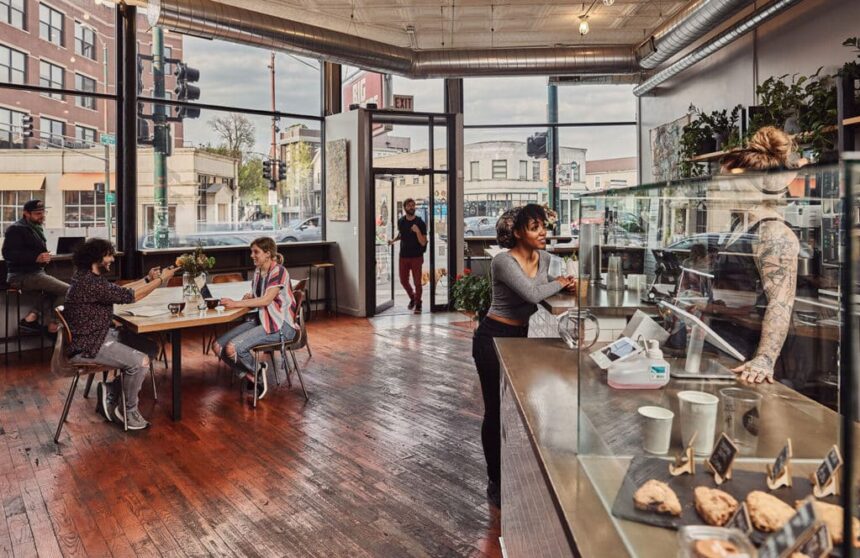
Independent cafés are under pressure like never before. Rising costs, aggressive pricing from big chains, and a cost-conscious public have all collided into one bold question: can a local coffee shop really serve a great cup for three dollars?
The $3 Coffee Challenge Explained
The $3 coffee challenge is not just a discount. It is a statement.
The idea is simple on the surface: offer a quality cup of coffee for three dollars and prove that good coffee does not have to be expensive. But underneath, the challenge reflects deeper tensions in the American coffee scene, where inflation has turned everyday habits into financial decisions.
For many customers, coffee used to be a small indulgence they did not question. Now, it is one of the first places people look to cut back.
Why Independent Cafés Are Joining the Fight
Independent cafés do not compete on scale. They compete on meaning.
Local coffee shops have always relied on relationships, atmosphere, and craft. The $3 coffee challenge allows them to push back against the idea that affordability belongs only to large chains. For owners, it is also a way to bring hesitant customers back through the door.
This mindset connects closely with the broader economic pressure explored in Side Hustle Nation: Why Everyone Has a Second Job, where Americans are reassessing spending and value across the board.
Can Quality and a $3 Price Coexist?
This is where the challenge gets real.
Independent cafés cannot rely on massive supply contracts or automated systems. To make three-dollar coffee work, many are rethinking operations from the ground up.
Some are simplifying menus to reduce waste. Others partner directly with local roasters to stabilize pricing. Many cafés use the $3 cup as an entry point, knowing that customers often return for pastries, specialty drinks, or higher-margin items.
As Forbes has noted, small food businesses that survive economic pressure tend to do so by tightening operations rather than racing to the bottom.
What Customers Are Saying Online
The conversation around the $3 coffee challenge is loud and emotional.
On TikTok, users praise local cafés for “keeping coffee human.” Many videos show people proudly choosing independent shops over chains, especially when prices feel fair.
Reddit threads reveal a more analytical tone. Users break down costs, compare cup sizes, and debate whether three dollars is realistic long term.
On X, reactions often mix surprise and support. For commuters and students, a three-dollar cup feels like relief rather than luxury.
Independent Cafés vs Big Chains
Big chains win on consistency and convenience. Independent cafés win on experience.
Chains can absorb price pressure because coffee is often a loss leader. Independent cafés cannot afford that luxury, which makes the $3 challenge both risky and symbolic.
The difference lies in why people choose where to buy coffee. Chains are transactional. Local cafés are relational. Customers return not just for caffeine, but for familiarity and community.
This distinction mirrors the cultural shift toward intentional consumption discussed in The Digital Detox Challenge: Unplugging Is the New Glow-Up, where people seek fewer but more meaningful daily rituals.
The Cultural Impact of the $3 Coffee Challenge
Cafés have always been more than places to drink coffee.
According to The New York Times, American cafés function as community spaces, work zones, and social anchors. Lowering the barrier to entry makes these spaces more accessible, especially to younger and lower-income customers.
The $3 coffee challenge quietly pushes back against the idea that café culture is exclusive or overpriced.
How Independent Cafés Are Making It Work
Owners who succeed with the challenge tend to share a few strategies.
They streamline menus. They focus on high-quality drip coffee rather than complex drinks. They communicate openly with customers about costs and sourcing. Most importantly, they treat the $3 cup as part of a bigger story, not a permanent discount.
As BBC Worklife has highlighted, transparency builds trust during economic strain.
Is the $3 Coffee Challenge Sustainable?
The honest answer is that it depends.
For some cafés, it is a short-term signal of solidarity with customers. For others, it becomes a long-term pricing anchor. What matters most is whether customers understand the value behind the cup.
Research into consumer behavior from MIT Technology Review suggests that people are willing to pay more when they trust the business. The $3 coffee challenge works best when it opens that trust, not when it replaces it.
What This Means for the Future of Local Coffee
The $3 coffee challenge is not about cheap coffee. It is about redefining value.
Independent cafés are reminding Americans that price is only one part of the equation. Quality, connection, and care still matter. In a world where everything feels more expensive, that reminder may be the strongest brew of all.
FAQ
What is the $3 coffee challenge?
It’s a movement encouraging cafés to offer a quality cup of coffee for around three dollars to emphasize value and accessibility.
Can independent cafés really compete with big chains on price?
They can compete selectively by simplifying operations and focusing on core offerings.
Do customers care more about price or quality?
Most care about both, but trust and experience often tip the balance.
Is the $3 coffee challenge a long-term trend?
It may evolve, but the push toward intentional pricing and transparency is here to stay.