Tiny nuclear reactors are stepping out of science fiction and into America’s real energy strategy. What once sounded experimental is now emerging as a serious solution for powering some of the country’s most remote and demanding locations.
Why Tiny Nuclear Reactors Are Suddenly Everywhere
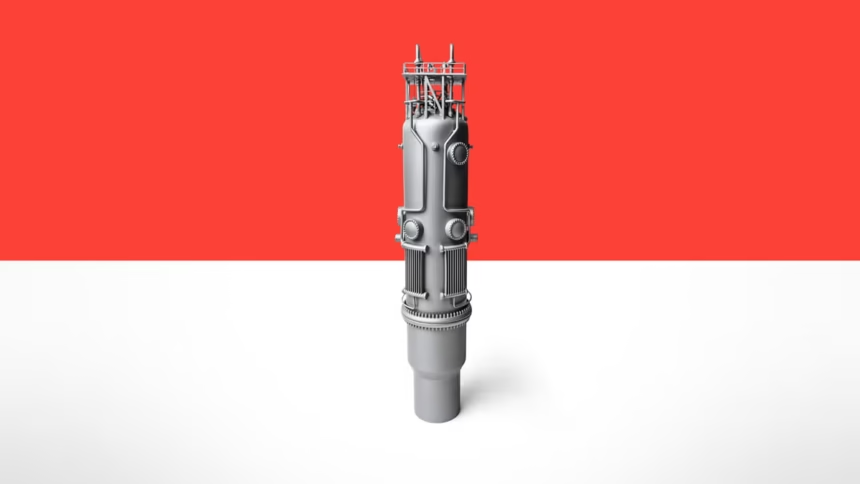
The conversation around nuclear energy has shifted fast. Tiny nuclear reactors, often called small modular reactors or SMRs, are being positioned as a smarter, more flexible alternative to traditional nuclear plants.
Unlike massive facilities that take decades to build, these compact reactors are designed to be deployed faster, scaled as needed, and installed where large plants simply do not make sense. This shift mirrors how other disruptive technologies have quietly moved from niche to necessity, a pattern BigTrending has explored in how breakthrough innovations redefine entire industries.
What Makes SMRs Different From Traditional Reactors
The key advantage is modularity. Components are built in factories, shipped to sites, and assembled with far less construction risk. Many designs rely on passive safety systems that reduce the need for constant human intervention, an important factor for isolated locations.
Powering the Places the Grid Cannot Reach
Remote towns, military installations, Arctic communities, and research facilities often depend on diesel generators that are expensive, polluting, and unreliable. Tiny nuclear reactors offer a cleaner and far more stable alternative.
According to analysis from MIT Technology Review on grid resilience and SMRs, distributed nuclear power could become a cornerstone of future energy systems where extending the grid is impractical or impossible.
Why Remote U.S. Sites Are the Perfect Test Case
Places like Alaska or remote defense bases require constant, uninterrupted power. Weather, geography, and logistics make fuel delivery difficult. Tiny nuclear reactors can operate for years without refueling, making them uniquely suited for these environments.
The U.S. Policy Push Behind the Nuclear Comeback
This technology is not moving forward by accident. Federal policy is actively encouraging nuclear innovation as part of a broader decarbonization and energy security strategy.
The New York Times’ reporting on America’s nuclear revival highlights how government funding and streamlined regulation are accelerating SMR development. For policymakers, tiny nuclear reactors are not just about clean energy, but also about national resilience.
Energy Independence and National Security
Reliable domestic power sources reduce reliance on imported fuels and strengthen critical infrastructure. In an era of climate volatility and geopolitical tension, energy predictability carries strategic weight.
Social Buzz Around Tiny Nuclear Reactors Is Growing
Public perception of nuclear energy is evolving, and social platforms reflect that shift.
Reddit reaction:
“Finally, a way to cut carbon emissions without relying entirely on solar and wind. Tiny nuclear reactors actually make sense.”
TikTok reaction:
“These tiny reactors powering remote areas feel like the future just showed up early.”
X user reaction:
“Tiny nuclear reactors could be the most practical clean energy solution we’ve ignored for too long.”
The tone is cautious but increasingly optimistic, especially when reactors are framed as tools for remote sites rather than dense urban centers.
The Road Ahead for Tiny Nuclear Reactors
Challenges remain. Regulatory approval, upfront costs, and lingering public concerns still slow deployment. However, momentum is clearly building.
Wired’s deep dive into next-generation nuclear technology notes that continued innovation and policy backing could bring SMRs online sooner than many expect, especially in controlled, remote environments.
For readers tracking long-term sustainability trends, BigTrending has shown how unconventional solutions often gain acceptance once real-world results appear, much like other once-controversial technologies discussed in the future of lab-grown innovation.
Why Tiny Nuclear Reactors Matter More Than You Think
This is not about replacing renewables. It is about complementing them. Tiny nuclear reactors offer steady, carbon-free power where solar and wind struggle, filling critical gaps in the energy transition.
If successful, these compact reactors could redefine how America thinks about clean energy, especially beyond major cities. Quietly, steadily, and far from the spotlight, tiny nuclear reactors may end up doing some of the heaviest lifting in the country’s energy future.
FAQ
What are tiny nuclear reactors?
Tiny nuclear reactors, also known as small modular reactors, are compact nuclear systems designed to deliver reliable power at a smaller scale.
Why are tiny nuclear reactors useful for remote U.S. sites?
They provide long-term, stable energy without relying on fuel deliveries or large grid connections.
Are tiny nuclear reactors safe?
Modern designs emphasize passive safety systems and simplified operation to reduce risk.
When could tiny nuclear reactors become widely used?
Pilot projects are already underway, with broader deployment expected later this decade if approvals continue.