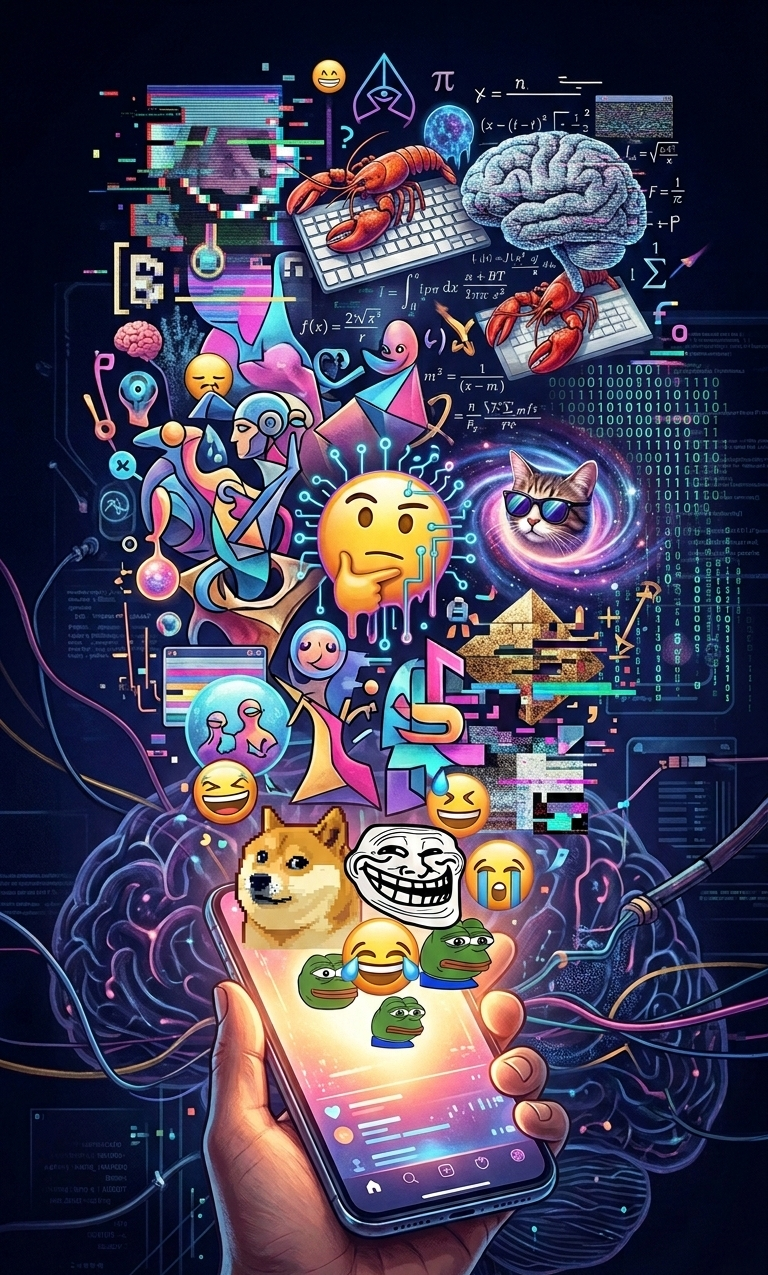
Internet humor isn’t just trying to make you laugh anymore. It’s trying to make you get it and sometimes, that’s the whole joke.
Internet humor didn’t get weirder by accident
Open any app and you’ll see it: jokes that look like nonsense, captions that read like riddles, videos that reward you for noticing one tiny detail, and memes that feel like they were written by a committee of sleep-deprived philosophers.
That’s not your imagination. Internet humor has evolved into something faster, denser, and more self-aware, because the internet itself trained it that way. The punchline isn’t always “haha” anymore, it’s “ohhh… wait… I see what you did there.”
The algorithm trained your brain for speed-reading jokes
Scroll speed changed comedy.
The old internet had time for setup: a long caption, a reaction image, maybe a comment thread building momentum. Now, the feed is a conveyor belt. Humor has to land instantly or it dies. So creators compress jokes the way editors compress headlines: cut the fluff, keep the signal, make it hit in under two seconds.
That’s why memes became shorthand. They’re cultural macros. A single image can carry an entire mood, a worldview, a political stance, or a shared trauma from last week’s trending discourse.
If you want the cleanest baseline on what we even mean by “meme” in 2026 terms, start with how memes spread and mutate online. It’s the simplest way to explain why jokes now evolve like species: remixable, survivable, and constantly adapting to new environments.
The new punchline is recognition, not surprise
Traditional comedy loves surprise. Internet humor loves recognition.
The laugh comes from realizing the creator and the audience share the same mental browser tabs: the same niche reference, the same viral sound, the same “I can’t believe we all lived through that” moment.
That’s why the internet keeps moving toward self-referential comedy. The joke is often about the fact that there’s a joke. The content is comedy, but it’s also commentary on comedy.
If you want a great cultural framing for this, The WIRED Guide to Memes nails the idea that memes aren’t just jokes, they’re how the hive mind communicates.
From “LOL” to layered irony: why jokes now feel like puzzles 🧩
Here’s the vibe shift: internet humor started as something you consumed. Now it’s something you decode.
The modern meme often has multiple layers:
- the obvious joke
- the ironic version of the joke
- the meta commentary about why that joke exists
- the “this is funny because it’s not funny” layer
- and sometimes a bonus layer only three people on the planet understand, which somehow makes it even funnier
It’s basically comedy with lore.
Meta-humor is basically a group chat inside a group chat
Meta-humor is what happens when the internet becomes self-aware and starts laughing at itself like it’s watching its own sitcom.
Examples:
- A meme that mocks the format of memes
- A TikTok that parodies TikTok “explainer voice” while still being an explainer
- A joke that only works if you remember the discourse about the discourse
This is why modern internet humor feels exclusive but also everywhere. It’s an inside joke with millions of participants.
If you want to stay fluent without living online 24/7, it helps to follow a curated stream of what’s trending and why it’s funny. That’s where BigTrending’s funniest trend rabbit holes come in handy: it’s basically a cheat sheet for the jokes people are currently building on.
Context is the new currency (and being lost is part of the bit)
Here’s the part nobody says out loud: confusion isn’t a bug, it’s a feature.
A lot of jokes now are designed to make you feel slightly behind, because being behind makes you curious. You lean in. You rewatch. You read comments. You join the culture.
That loop is powerful. It turns humor into engagement, and engagement into status. Getting the joke means you’re “in.” Missing it means you’re motivated to catch up.
If you want the deeper “why this feels like a cultural movement” angle, a deeper academic read on memes and modern irony is surprisingly useful. It puts language to that odd mix of sincerity and irony that defines a lot of today’s meme humor.
And yes, even if you don’t read the whole thing, it’s validating to know your brain isn’t broken. The joke really is doing five things at once.
Absurdism is the meme era’s default setting 🤯
Absurd memes used to be a niche. Now they’re the default tone.
A banana with a sad caption. A low-res clip of a cat with existential text. A video that’s just a dramatic zoom on someone’s face while a completely unrelated audio plays. The point isn’t logic, it’s emotional accuracy.
Absurdism is what you get when reality becomes too heavy to process straight.
Random isn’t random when everyone shares the same stress
A lot of “nonsense humor” is actually pattern-matching.
People are overwhelmed. News cycles are exhausting. Work feels like an endless scroll of tasks. Politics is loud. Prices are louder. So comedy adapts by becoming a pressure valve.
Absurd memes are the internet’s way of saying: “I don’t know what’s happening either, but I’m here and I’m coping.”
Also, humor goes where people are. The current platform mix matters because the format shapes the joke. If you want a strong snapshot of modern platform usage in the US, where people actually spend time online now helps anchor the “why this kind of humor wins” argument.
Memes as modern art: ugly, brilliant, and kind of true
There’s a reason people keep comparing memes to abstract art. Both are:
- weirdly emotional
- context-dependent
- sometimes intentionally ugly
- and oddly satisfying when it clicks
Memes also became a creative industry. People build entire brands on comedic formats, recurring characters, edits, and “this is my niche and I own it” energy.
And comedy isn’t just migrating within platforms, it’s migrating between platforms in unexpected ways. A perfect example: comedians going direct-to-fan and experimenting outside traditional networks. If you want to see how that shift looks in the wild, how creators are reshaping comedy platforms is a sharp case study in where comedy culture is heading.
TikTok turned comedy into a live lab (and we’re all unpaid researchers)
TikTok didn’t just popularize jokes. It changed the mechanics of humor.
It rewards:
- speed
- editing
- timing
- remix culture
- and community participation
The funniest TikToks aren’t always the best “bits.” They’re often the best format hacks.
Short-form humor rewards the cleverest edit, not the best setup
In classic standup, you build. On TikTok, you snap.
A pause, a cut, a look to camera, a text overlay, a sound that signals the punchline before you even speak. The structure is closer to music than comedy: rhythm matters as much as content.
If you want a clean explainer that matches the “comedy levels” vibe of your draft, check The Levels of Internet Humor. It maps nicely to the idea that humor isn’t one thing anymore, it’s a ladder people climb together.
“IYKYK” is now a full storytelling format
The internet loves “IYKYK” because it creates instant community.
A joke can be:
- a reference to a moment
- a callback to a meme format
- a nod to a niche fandom
- or a subtle signal that you share the same worldview
And because memes are collaborative, the comment section becomes part of the punchline. People add the next layer. They remix it. They escalate it. The original post is just the starter.
If you want the foundational explanation of why this spreads so fast and mutates so easily, revisit how memes spread and mutate online and you’ll see the logic behind the chaos.
Why we love smarter, stranger internet humor
This is the part that matters: the new wave of internet humor isn’t just “content.” It’s a coping tool, a social language, and sometimes a sneaky way to test whether you’re paying attention.
It’s coping, community, and a tiny IQ test at the same time
You don’t just laugh, you participate.
You prove you understand the vibe. You reply with the correct reaction image. You use the right sound. You stack a meme on top of a meme like a cultural Jenga tower.
That’s why a lot of people say modern internet humor is “smarter.” It often requires pattern recognition, cultural memory, and context decoding.
And again, platforms shape behavior. The reason TikTok humor feels different from Reddit humor is because the incentives are different. If you want the “big picture” of what people are using and how frequently, where people actually spend time online now gives you a credible grounding point.
Real social reactions that capture the vibe:
- A TikTok user: “I laughed, then I had to rewatch because the joke had… lore.”
- A Redditor: “Half the comedy now is realizing you missed the first layer.”
- An X user: “Internet humor feels like speedrunning cultural references at 2x.”
The joke is a cultural mirror, not just a distraction
Internet humor has always reflected the moment. But now it does it with sharper tools.
Memes respond to:
- politics
- social norms
- identity
- anxiety
- trends
- and the feeling of being online too much
The jokes can be playful, but the subtext can be real. That’s why internet humor feels “stranger” too. It’s not always trying to comfort you. Sometimes it’s trying to show you the absurdity of everything.
If you want a strong cultural explanation of memes as more than laughs, The WIRED Guide to Memes is one of the cleanest mainstream reads that treats meme culture like a real communication system.
The future of internet humor: smarter, stranger, more collaborative
So where does this go next?
The direction is pretty clear:
- faster micro-trends
- deeper in-jokes
- more remixing
- more “this is funny because it’s a format” humor
- and more overlap between comedy, commentary, and identity
What to watch next: AI remixing, deeper in-jokes, faster micro-trends
AI is already nudging humor toward even more surreal remix culture. Not because robots are funny (sometimes they’re not), but because they make it easier to generate variations, visuals, and weird combinations at scale.
That doesn’t replace human humor. It amplifies the internet’s favorite mode: remix.
If you want language for the bigger cultural shift, a deeper academic read on memes and modern irony is useful here again, because the future of humor looks like a constant oscillation between sincerity and irony.
How to keep up without feeling old overnight
Practical pro tips for staying fluent in modern internet humor without losing your mind:
- Follow formats, not creators. The format is what spreads. Once you recognize it, you’ll get the joke faster.
- Read comments like subtitles. The internet often explains itself in the replies.
- Save a few “trend translators.” A good curated source turns chaos into context.
- Don’t force it. Being slightly behind is part of the fun. The internet will pull you in when it’s ready.
And if you want a steady stream of what’s funny and why, BigTrending’s funniest trend rabbit holes is the easiest “catch me up” button.
FAQ
Why is internet humor getting smarter?
Internet humor is getting smarter because it’s built on layered references, remix culture, and shared context. The more online you are, the more those layers become readable.
What makes internet humor feel so strange lately?
Internet humor often leans into absurdism and meta-jokes as a response to stress, overload, and nonstop feeds. Strange humor is a fast way to process a chaotic world.
Is TikTok changing internet humor?
Yes. TikTok rewards speed, editing, and remixing, which pushes internet humor toward formats that land instantly and evolve quickly through trends.
How do I understand internet humor if I keep missing the jokes?
Focus on recognizing formats and recurring references. Reading comments helps, and following a few curated trend sources makes the context easier to pick up.
Will internet humor keep evolving?
Absolutely. Internet humor will keep getting faster, more collaborative, and more layered, especially as AI tools make remixing even easier.