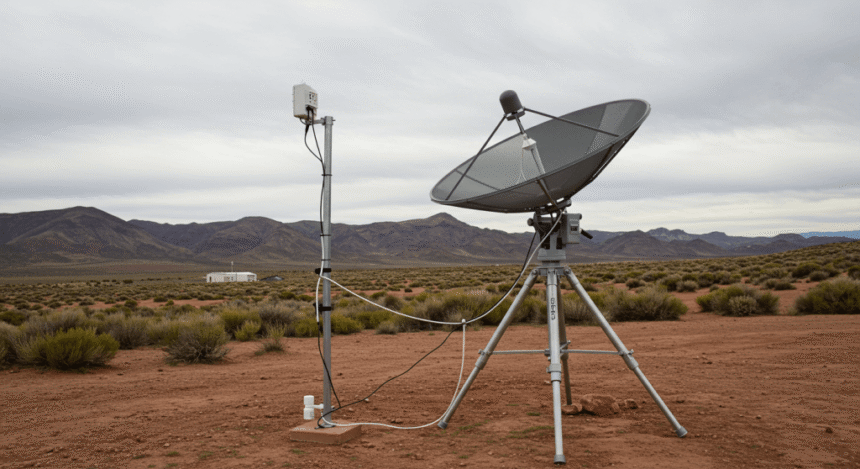
Satellite internet is no longer science fiction. It’s quickly becoming one of the most important breakthroughs in American connectivity. With early tests rolling out from coast to coast, the data is starting to show what this new era of sky-powered internet really means for everyday life — and the results are turning heads.
What Satellite Internet Is and Why It Matters 🌌
Satellite internet uses orbiting satellites — not buried cables — to deliver high-speed connections directly from space. Instead of relying on fiber or copper lines under the ground, a constellation of satellites beams connectivity down to a small receiver on the ground.
This means internet access is no longer limited by geography. Mountains, deserts, forests, farmlands, and remote regions no longer block the signal.
A Reddit user summed it up perfectly:
“Satellite internet is the first time my town has had real high-speed anything.”
Why Satellite Internet Is Exploding Now
Several factors converged to push satellite internet into the spotlight:
- Launch costs fell dramatically
- New low-orbit satellites reduce latency
- Remote work demand skyrocketed
- Digital learning exposed broadband gaps
- Private companies accelerated innovation
Americans want universal connectivity — and satellites finally make that possible.
How Satellite Internet Is Transforming U.S. Connectivity 📶
The first wave of testing is producing impressive results. According to the NYTimes, satellite internet speeds now rival traditional broadband in many cases. Early adopters report fast download speeds, stable video calls, and smoother streaming.
Satellite internet offers:
- High-speed coverage in previously dead zones
- Stronger rural connections
- Backup internet for emergencies
- New possibilities for remote communities
One TikTok creator joked:
“Satellite internet might save my sanity. No more buffering during Zoom calls.”
The Latency Problem (And Why It’s Getting Better)
A longtime weakness of satellite internet was lag — the delay between sending data and receiving a response. Traditional satellites were extremely far from Earth. Today’s new generation uses low Earth orbit satellites that sit far closer.
That means:
- Faster response times
- Smooth video chats
- Reliable gaming
- Real-time cloud work
Latency is no longer the dealbreaker it once was.
Bridging the Digital Divide in Rural America 🌍
For rural communities, satellite internet is more than convenience — it’s life-changing.
Many remote counties cannot get fiber or cable due to cost or geography. Satellite networks bypass those limitations entirely.
Forbes reports that satellite connectivity is becoming a major tool for:
- Rural education
- Telehealth access
- Farm technology
- Small business growth
- Digital job opportunities
One X user captured the emotion behind it:
“This might be the first time rural folks get equal access to the digital world.”
Who Benefits the Most
- Farmers using connected equipment
- Students learning remotely
- Remote workers
- People in mountainous or isolated regions
- Healthcare patients using telemedicine
Satellite internet doesn’t just bridge the digital divide. It helps close the opportunity gap.
Future Prospects: The Sky’s the Limit 🚀
This technology is still in its early stages, but the roadmap is massive. Companies are planning giant constellations of satellites — thousands of them — to deliver global coverage.
According to Wired, future satellite networks will support:
- Self-driving cars
- Smart highways
- Global IoT device syncing
- Disaster response systems
- Remote robotics
- Fully connected smart cities
Satellite internet could become one of the primary ways the world stays online.
Risks and Unknowns
Of course, no technology is flawless. Concerns include:
- Space debris
- Light pollution
- Potential satellite congestion
- Regulatory hurdles
- Weather interference
- Higher equipment costs
But innovation is moving fast, and most issues have clear solutions under development.
Satellite Internet and Digital Culture 📱
More connectivity means more participation in global digital culture. Rural creators, remote workers, online learners, and small-town entrepreneurs can now join the same conversations as big-city users.
Satellite internet strengthens:
- Social media reach
- Online business opportunities
- Creative sharing
- Digital inclusion
- Community activism
It transforms who gets to participate — and how loud their voices can be.
To explore how digital ecosystems are shifting, check out our article on the 5G Revolution. Together, satellite and 5G form a powerful duo in America’s connectivity future.
Technical Breakdown: How It All Works
Satellite internet works using three main components:
- Orbiting satellites that beam signals to Earth
- Ground stations that connect satellites to the global internet backbone
- User terminals that receive the signal
The technology supports high-speed downloads and uploads by distributing loads across many satellites instead of just one.
Next-gen models even use laser links between satellites to transmit data across space at incredible speeds — bypassing ground infrastructure completely.
Challenges Satellite Internet Must Overcome ⚠️
While early results look great, several challenges must be solved before nationwide adoption.
Connectivity Consistency
Heavy rain or snow can reduce signal quality. Most modern satellites handle this much better, but it’s still a factor.
Equipment Costs
Receiver units and installation can be pricey, though costs are decreasing.
Regulatory Oversight
The government must manage spectrum access, satellite permissions, and orbital spacing rules.
Space Management
With thousands of satellites planned, collaboration is needed to avoid congestion.
These challenges aren’t fatal — but they must be addressed for the technology to scale.
The Bigger Picture: A New Era of Global Connectivity
Satellite internet marks a cultural and technological shift. The idea that anyone — anywhere — can be instantly connected is transformational.
To see how this ties into broader workforce changes, explore our article on AI Co-Workers. New connectivity shapes how Americans work, collaborate, and innovate.
This is more than infrastructure. It’s empowerment.
FAQ: Satellite Internet
How does satellite internet work?
It uses orbiting satellites to send internet signals to receivers on the ground, creating high-speed connections without cables.
Is satellite internet available everywhere?
Coverage is expanding rapidly, but availability still depends on the provider and the current satellite constellation.
What are the benefits over broadband?
It reaches remote areas that broadband cannot, offering high-speed alternatives in places with limited infrastructure.
Are there downsides?
Weather interference, latency (though improving), and equipment costs are the main challenges.
What’s the future of satellite internet?
Expect global coverage, faster speeds, AI integration, smart city connectivity, and thousands of satellites working together.