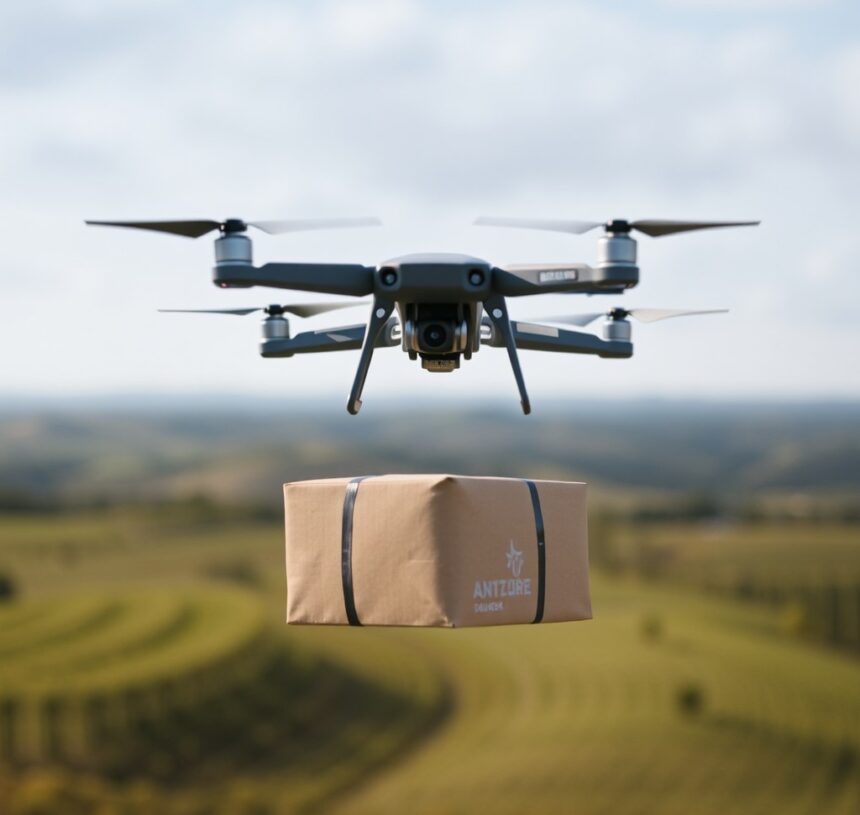
Suburban delivery drones are no longer a futuristic idea floating above tech conferences. They are already flying over driveways, backyards, and cul-de-sacs, turning quiet neighborhoods into real-world testing grounds for the future of delivery.
Why Delivery Drones Are Targeting Suburban Neighborhoods
Suburbs hit a rare sweet spot for experimentation. They are dense enough to justify logistics investment but open enough to manage safety risks.
Urban areas are cluttered with tall buildings, crowded airspace, and regulatory complexity. Rural zones lack the order volume needed to test scale. Suburban delivery drones thrive in between. Wide streets, predictable layouts, and lower air traffic make them ideal proving grounds.
This mirrors broader logistics shifts explored in The Future of Last-Mile Delivery Is Already Here, where efficiency gains increasingly come from rethinking the final stretch to the customer.
How Suburban Delivery Drones Actually Work
Despite the sci-fi visuals, the mechanics are surprisingly methodical.
Navigation, GPS, and Obstacle Avoidance
Delivery drones rely on layered systems. GPS handles routing, while computer vision and sensors detect trees, power lines, and buildings. Many drones also use predefined corridors to limit unpredictable flight paths.
Drop-Off Systems and Safety Protocols
Most suburban delivery drones do not land. Instead, they lower packages using tethers, minimizing contact with people, pets, or property. Weight limits are strict, and delivery zones are pre-approved by customers.
If conditions are unsafe, wind too strong or space too crowded, the delivery simply does not happen.
The Companies Running These Pilot Programs
Amazon Prime Air and Alphabet’s Wing are leading the charge, but they are not alone. Retailers, pharmacies, and healthcare providers are watching closely.
The New York Times has detailed how Amazon’s drone program focuses heavily on safety and redundancy, reflecting how high the stakes are for public acceptance.
For these companies, drone delivery is not about novelty. It is about cutting last-mile costs, which remain the most expensive part of logistics.
What Residents Are Experiencing on the Ground
For many residents, the first reaction is curiosity. Seeing a drone descend with a package feels surreal. Speed is the biggest immediate benefit. Deliveries that once took hours arrive in minutes.
But concerns follow quickly. Noise levels, visual clutter, and the idea of flying machines over private property spark debate. Some communities embrace the pilots. Others push back.
This tension echoes themes BigTrending has covered in Smart Cities Are Quietly Rewriting Daily Life, where innovation often arrives before consensus.
Social Reactions Reveal Curiosity and Concern
On TikTok, suburban delivery drones are treated like spectacle. Videos capture first-time deliveries with excitement and disbelief.
Reddit discussions are more grounded. Users question reliability, weather limits, and whether drones can ever handle real delivery volume.
On X, reactions mix humor and skepticism. Jokes about drone traffic jams sit next to serious threads about regulation and privacy.
The public mood is not hostile. It is cautiously curious.
Economic and Environmental Impacts
From a business perspective, suburban delivery drones promise major savings. Fewer trucks mean lower fuel costs, faster delivery windows, and reduced congestion.
Environmentally, the picture is mixed. Electric drones produce fewer emissions than gas-powered vans, but only if scaled responsibly. Short flights with light payloads make sense. Replacing every truck does not.
According to Wired’s analysis of drone logistics, drones are most effective as supplements, not replacements.
Privacy, Noise, and Ethical Questions
Privacy remains the biggest concern. Even if drones are not recording footage, the perception of surveillance matters.
Pew Research shows that public acceptance of new technology depends heavily on transparency and clear limits. Residents want to know what drones collect, where they fly, and who controls the data.
Noise is another factor. A few drones are tolerable. Dozens become intrusive. Regulators are watching closely.
Is This the Future of Everyday Delivery?
Suburban delivery drones are not about replacing delivery trucks tomorrow. They are about expanding options.
Groceries, prescriptions, and urgent items are the most likely use cases. Heavy packages and bulk orders will remain ground-based for years.
But if pilots continue to show gains in speed, safety, and cost, drone delivery will quietly scale. Not everywhere. Not all at once. But enough to permanently change expectations.
FAQ
How do suburban delivery drones work?
They use GPS, sensors, and automated flight systems to deliver lightweight packages directly to approved residential locations.
Why are drones tested in suburbs first?
Suburbs offer open airspace, predictable layouts, and enough delivery volume to test safely and efficiently.
Are delivery drones safe and legal?
They operate under strict regulations and pilot programs approved by aviation authorities.
Will drone delivery replace trucks?
No. Drones will complement traditional delivery, not fully replace it.
Suburban delivery drones are not just about faster packages. They are about redefining how infrastructure quietly adapts to everyday life, one backyard at a time.