Podcasts didn’t stop being podcasts. They just leveled up into something you can watch, binge, and clip like your favorite show. And the creators who understand visual podcasts right now are quietly building the next big media franchises.
Why “visual podcasts” suddenly feel inevitable 📺
If you feel like every “audio” show you follow is now showing up on your feed with studio lighting, multi-cam angles, and a suspiciously good set… you’re not imagining it. Visual podcasts are happening because the internet has moved from “listen while you do stuff” to “watch while you do stuff.” That sounds like the same thing, but it’s not.
Audio podcasts grew in a world of commutes, errands, and earbuds. Visual podcasts are growing in a world of screens everywhere: phones, laptops, TVs, second monitors, and that one iPad that lives in the kitchen like it pays rent.
From audio-first to screen-first habits
People still love audio. But attention has shifted toward “show me.” When your audience spends their day inside apps that reward visuals (and punish anything that can’t be clipped), it’s only natural that podcasts adapt.
And it’s not just comedy bros or celebrity interviewers turning on cameras. Even niche creators are doing it because video changes the economics of discovery. A random audio episode is hard to stumble into. A 30-second clip of a wild take, a surprising reaction, or a perfectly timed pause? That travels.
This is also why the podcast world keeps bleeding into mainstream celebrity culture. The same audience that follows streaming shows and pop culture moments also follows the personalities behind the mic. If you’ve been tracking the wave of celebrity podcasts that dominate 2025, you’ve already seen the blueprint: fans don’t just want information, they want proximity. Visual is proximity.
The YouTube effect (discoverability plus “TV time”)
Visual podcasts don’t explode in a vacuum. They explode when a platform makes them easy to find, easy to watch, and easy to share.
That’s why YouTube matters here. It isn’t just a place to upload video. It’s a search engine, a recommendation engine, and a “hang out on the couch” engine.
If you want the strategic version of what’s happening, here’s the clean takeaway: video podcasts are booming on YouTube because video turns a podcast from “something you follow” into “something the algorithm can introduce to strangers.”
When your show can appear next to videos people already watch, your audience growth starts behaving more like a channel than a feed.
What visuals add that audio can’t (and why people love it) 🎥
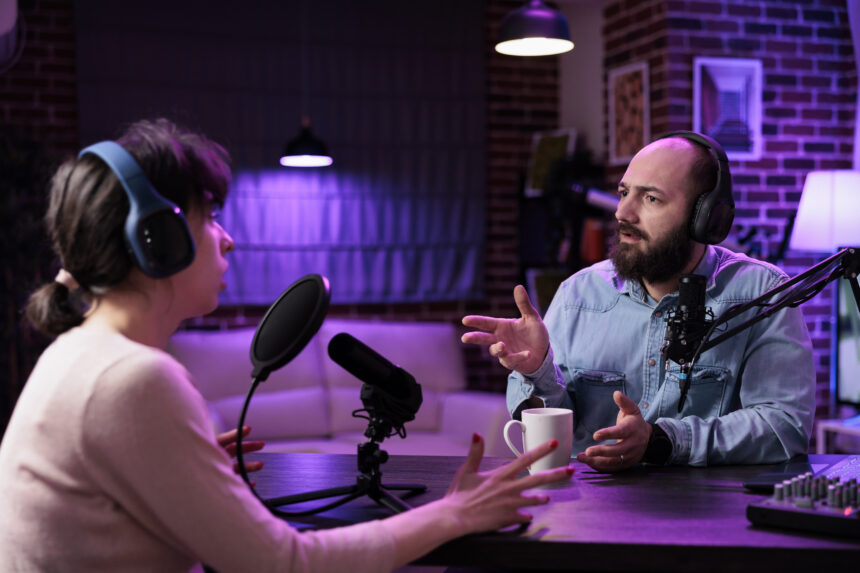
Turning on cameras isn’t a cosmetic upgrade. It changes the emotional texture of the show.
Audio gives you intimacy. Video gives you intimacy plus proof.
Body language, vibe, and “parasocial reality”
A good audio host can paint a picture. A good visual host doesn’t have to. The viewer sees the raised eyebrow, the grin before the punchline, the awkward sip of water after someone says something too real.
That’s the secret sauce: visual podcasts feel like a real room you get invited into weekly.
A TikTok user put it simply: “Audio is nice, but seeing the reactions makes it feel real.”
And the data angle lines up with the human angle. When viewers can see the people speaking, the content often feels more personal, more trustworthy, and more “hang-worthy.” That’s part of why advertisers and platforms are paying attention to how video podcasts are reshaping audience behavior.
Here’s what visual tends to unlock:
- Higher perceived authenticity: facial expressions and tone match in real time
- Better retention: it’s easier to stay locked in when there’s motion and micro-moments
- More shareable moments: clips carry emotion faster than audio snippets
- Stronger community: viewers feel like they “know” the hosts
A Redditor summed it up: “I didn’t get the hype until I watched one episode on my TV.”
That’s the shift. Your podcast becomes living-room content.
The creator playbook for launching a visual podcast (without burning out) 🛠️
Let’s be honest: “start a visual podcast” sounds glamorous until you realize you just added a part-time video production job to your life.
The good news: you don’t need a Hollywood set. You need a repeatable system.
Minimal studio setup that still looks premium
Most visual podcasts fail in the first month for one reason: the creator tried to build a studio like a Netflix special instead of a sustainable weekly workflow.
The winning move is “good enough, consistent, repeatable.”
Your baseline setup should prioritize three things:
- Clean audio (still the heart of the show)
- Stable framing (no shaky handheld chaos)
- Simple lighting (soft, flattering, reliable)
If you want a quick, practical walkthrough that’s actually beginner-friendly, Video Podcasting 101 is a solid reference because it focuses on fundamentals and workflow instead of gear flexing.
Pro tip: If you can’t afford multiple cameras, cheat smart:
- Use one main camera angle
- Add a second “wide” angle using a phone
- Cut only at natural moments (laughs, pauses, topic transitions)
That alone makes your show feel “produced” without making your life miserable.
Editing, clips, Shorts, and distribution rhythm
Here’s the truth nobody wants to hear: your full episode is not your growth engine. Your clips are.
Full episodes build depth. Clips build discovery.
Think like a movie studio:
- The episode is the film
- The clips are the trailer
- The Shorts are the teaser posters
A smart visual podcast workflow looks like this:
- Record one episode (60–90 minutes)
- Pull 5–10 “clip candidates” (moments with emotion, surprise, humor, or clarity)
- Publish:
- 1 full episode
- 3–5 short clips across the week
- 1–2 Shorts/Reels per day for 3–4 days
The key is not “post everywhere.” It’s “post with intention.”
If you want a mindset that keeps this sustainable, lean on smart cross-promotion ideas that scale and treat your show like a brand, not a random upload.
An X user nailed the modern reality: “Vodcast clips are the new trailer. If the clip hits, I’ll watch the whole thing.”
That’s exactly how discovery works now.
Monetization and the “vodcast economy” 💸
Visual podcasts don’t just change the vibe. They change the business model.
Audio ads are limited. Video ads are flexible.
With video, brands get:
- product placement
- logo visibility
- on-screen demonstrations
- stronger “I trust this host” energy
And that’s why money is moving toward this format. If you want the business lens, why vodcasts are exploding as a business format frames the shift in a way that makes it clear this isn’t just creators being extra. It’s an ecosystem pivot.
The three monetization tiers that actually work
Tier 1: Traditional sponsorship reads
The classic: host reads the ad, audience buys, brand renews.
Tier 2: Integrated segments
This is where video shines. Example: “Tool of the week,” “setup breakdown,” “taste test,” “live demo.” Visual makes it believable.
Tier 3: Community revenue
Memberships, paid communities, bonus episodes, behind-the-scenes, early access. Video makes these perks feel more tangible.
Mini case study (simple but real):
A creator launches an audio podcast and gets modest growth. Then they switch to a visual setup, create 30-second “highlight clips” that hook new viewers, and suddenly sponsors aren’t paying for downloads, they’re paying for attention across platforms. Same conversations, higher ceiling.
Is this the future or just “podcasts with cameras”? Real talk ⚖️
Not every show needs video. Some shows actually get worse with cameras because the host starts performing instead of connecting.
The goal is not to “be on camera.” The goal is to make the conversation better for the audience.
When video helps vs. when it’s just extra work
Video helps when:
- the show is personality-driven
- reactions and facial expressions add meaning
- guests are dynamic and comfortable on camera
- the format includes storytelling, demos, or behind-the-scenes
Video is extra work when:
- your show is heavily scripted and information-dense
- you record in messy environments you can’t control
- you don’t have time for post-production
- you’re doing it purely because “everyone else is”
There’s also a bigger industry reason cameras are turning on: platforms are competing for the same attention pool, and video is a more versatile attention format than audio alone.
If you want the macro “why now” argument, welcome to the age of the vodcast captures the reality that podcasts are increasingly behaving like TV.
What’s next for visual podcasts (formats we’ll see everywhere) 🔮
Visual podcasts are still early in terms of format innovation. Most shows are still “two people on a couch.” That’s fine, but the next wave is more creative.
Here’s what’s coming fast:
1) Live-to-clips pipelines
Recording live (even small audiences) creates energy. Then the show becomes a content factory:
- livestream
- full replay
- clips
- Shorts
- behind-the-scenes
2) Multi-cam storytelling without the fuss
Creators are learning the cheat codes:
- two cheap angles instead of four expensive ones
- fast cuts only when the moment earns it
- consistent framing so editing is easy
3) Audience participation as a feature
Visual podcasts will lean into comments, polls, live Q&A, and fan prompts, not as “engagement,” but as content fuel.
And as more money moves into video podcasting, the big question becomes less “is this a trend?” and more “what does this do to the creator economy?” That’s the kind of shift Deloitte is pointing at when discussing how video podcasts are reshaping audience behavior.
FAQ: Visual podcasts explained
What are visual podcasts, exactly?
Visual podcasts are podcasts recorded with video so people can watch the conversation, not just listen. Visual podcasts often live on YouTube and are built for clipping and sharing.
Do visual podcasts replace audio podcasts?
Not necessarily. Many creators publish both. Visual podcasts add a watchable version while still keeping audio feeds for listeners who prefer earbuds.
What equipment do I need to start visual podcasts?
To start visual podcasts, focus on clean audio, stable camera framing, and simple lighting. You can begin with one camera and a solid mic and upgrade later.
Are visual podcasts easier to grow?
Visual podcasts can be easier to grow because clips are highly shareable and platforms recommend video more aggressively. The key is consistent episodes plus consistent short-form highlights.
How do visual podcasts make money?
Visual podcasts monetize through sponsorships, integrated brand segments, memberships, and platform ad revenue. Video also increases brand value because products can be shown, not just described.